
Reviews
Signal Path Logic stands out for its elegant simplicity. The core mechanic of toggling switches to route a signal is immediately understandable, yet the puzzles grow cleverly complex. The three gate types offer just enough variety to keep the brain engaged without overwhelming. The lack of timers or penalties makes it a relaxing experience, ideal for short sessions or deep focus. The visual feedback is crisp, and the progressive difficulty ensures a steady learning curve. It is a well-crafted title for anyone who enjoys mental challenges.
About this game
Core Puzzle Principle
Signal Path Logic centers on directing a signal from its source to a final indicator light. Players interact with a series of switches that can be toggled between two states. The challenge lies in understanding how each gate in the circuit interprets these inputs. Some gates require both inputs to be active, while others need only one, and a third type blocks the signal unless both inputs are off. This creates a system where careful planning is essential.
Gate Behavior Breakdown
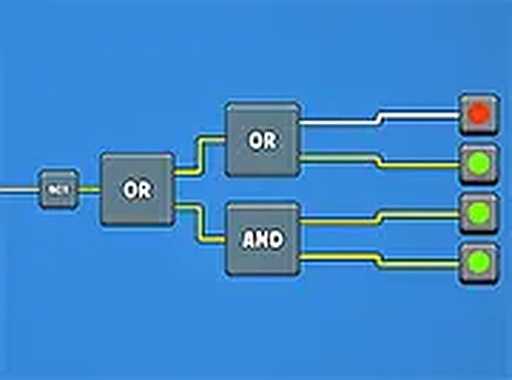
The game introduces three fundamental gate types, each with distinct rules. The first passes a signal forward only when both incoming lines are active. The second allows passage if at least one line is active. The third is more restrictive, permitting a signal only when no active input is present. Mastering these behaviors is key to solving later puzzles, as gates are often arranged in sequences or connected in branching paths.
Level Progression and Complexity
Early stages provide simple circuits with only a few gates, allowing players to learn the mechanics without pressure. As players advance, the layouts become more intricate. Gates may cross over one another, and signal paths can split or merge. This gradual increase in difficulty ensures that players build their logical reasoning skills step by step. Each solved puzzle rewards the player with a sense of accomplishment.
Visual Feedback and Interface
The interface is clean and uncluttered, with clear visual cues showing the state of each switch and the flow of signals. When a signal passes through a gate, the path lights up, giving immediate feedback. This helps players quickly identify which combinations work and which do not. The design is suitable for all ages, with no distracting animations or sounds.
Compatibility
• OS: Windows 10+, macOS 11+, iOS 14+, Android 10+
• Browsers: Chrome 100+, Safari 15+, Edge 100+, Firefox 100+
• Not compatible with Internet Explorer
Tested on real devices ✅ works as expected
Faq
Is Signal Path Logic free to play?
Yes, the game is completely free to play online. There are no hidden fees or in-app purchases required to access any level. You can enjoy the full experience without any cost.
Can I play Signal Path Logic on my phone?
Yes, the game is designed to work on both desktop computers and mobile devices. You can play it directly in your web browser on a smartphone or tablet without needing to download any app.
How many levels does Signal Path Logic have?
The game includes a large number of levels that gradually increase in difficulty. While the exact count is not specified, players can expect many hours of puzzle-solving content as they work through increasingly complex circuits.
What happens if I get stuck on a puzzle?
There is no time limit, so you can take as long as you need. You can also reset the puzzle and try a different approach. Experimenting with different switch combinations is encouraged, and the visual feedback helps you learn from each attempt.
Is Signal Path Logic suitable for children?
Yes, the game is family-friendly and suitable for players of all ages. The simple interface and lack of time pressure make it a great tool for teaching basic logic and problem-solving skills to younger players.
Do I need any prior knowledge of electronics to play?
No prior knowledge is required. The game teaches the behavior of each gate type through play. The rules are easy to learn, and the early levels are designed to help beginners understand the mechanics without any technical background.










Comments
0 comments