
Reviews
Train Route Builder Challenge stands out for its thoughtful level design. Each puzzle feels like a small architectural problem where every piece must fit precisely. The lack of timers or pressure allows players to think at their own pace, which is rare in puzzle games. Visuals are simple but effective, and the interface is intuitive. While the game does not offer multiplayer or story elements, its core mechanic is strong enough to keep players engaged for many sessions. It is a solid choice for anyone who enjoys spatial reasoning challenges.
About this game
Core Puzzle Mechanics
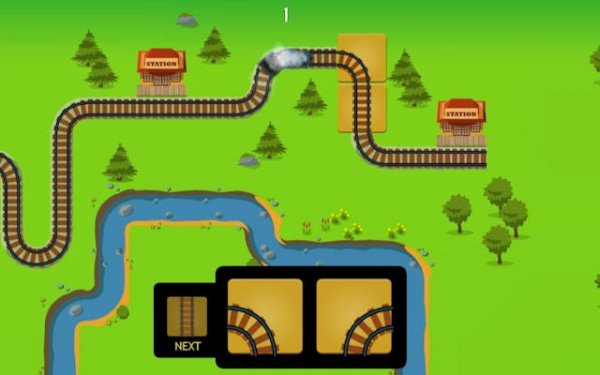
In Train Route Builder Challenge, players receive a set number of track components such as straight rails, curves, and switches. The objective is to arrange these pieces on a grid so that they form an unbroken route from the train's starting depot to the target station. Every piece provided must be used, which means careful planning is essential. There is no room for extra or missing segments. This design encourages logical thinking and spatial reasoning, as each decision affects the overall path.
Level Structure and Difficulty
Levels begin with simple layouts that introduce basic track shapes and gradually increase in complexity. Later puzzles require more intricate arrangements, often involving multiple switches or tighter spaces. The progression feels natural, allowing players to build confidence before tackling harder challenges. Each stage is self-contained, so there is no penalty for restarting. This structure makes the game suitable for both children and adults who enjoy thoughtful problem-solving.
Visual Design and User Interface
The interface is clean and uncluttered, with a clear view of the grid and an inventory panel showing available pieces. Track segments are visually distinct, making it easy to identify straight sections from curves. Colors are soft and muted, reducing eye strain during longer play sessions. The train animation plays smoothly once a route is completed, providing a satisfying reward. No distracting elements pull attention away from the puzzle itself.
Strategic Planning Tips
Before placing any pieces, it helps to visualize the entire route. Consider how each curve and switch will connect to form a continuous line. Using all pieces efficiently often requires backtracking and trying alternative layouts. If a path becomes blocked, removing a few segments and starting from a different point can lead to a solution. Regular practice improves the ability to spot patterns and anticipate conflicts.
Compatibility
This H5 game runs smoothly on:
• Desktop computers (Windows / Mac) • Mobile phones (iPhone / Android)
• Tablets (iPad / Android)
🌐 Best experienced with Chrome, Safari, or Edge
Faq
Is Train Route Builder Challenge free to play?
Yes, the game is available online at no cost. There are no hidden fees or subscriptions required to access any levels.
Do I need to download any software to play?
No download is necessary. The game runs directly in a web browser on most devices, including computers and tablets.
What age group is this game designed for?
The puzzles are appropriate for children aged six and up, but the increasing difficulty also appeals to teenagers and adults who enjoy logic challenges.
How many levels are available in the game?
The number of levels is not specified, but the game includes a gradual progression from simple to complex puzzles, offering many hours of play.
Can I play this game on a mobile phone?
The game is designed to work on touchscreen devices, so it should be playable on smartphones and tablets through a web browser.
What happens if I get stuck on a level?
There is no time limit or penalty for restarting. You can clear the grid and try a different arrangement at any time without losing progress.









Comments
0 comments